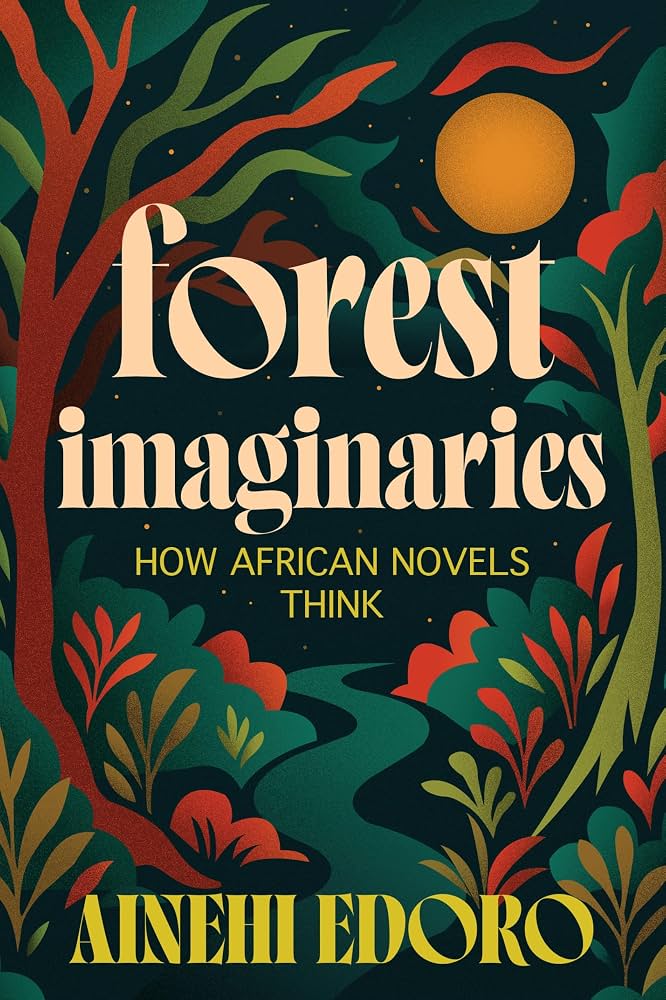
I’ve been enjoying a new way of reading by pairing two books together and exploring the common threads between them. In doing so, I’ve found great value in discovering works that expand the intertextual conversations around subjects that interest me. One such area is philosophy and meaning-making in African literary studies, which is why I was immediately drawn to Dr. Ainehi Edoro‘s Forest Imaginaries: How African Novels Think.
Dr. Ainehi Edoro is a Nigerian literary scholar whose work focuses on African literature and digital culture. She is the Mellon Morgridge Assistant Professor of English and African Cultural Studies at the University of Wisconsin–Madison. Edoro is also the founder and editor of Brittle Paper, a leading online platform dedicated to African literary culture.
Forest Imaginaries: How African Novels Think examines the importance of the forest in African novels through both philosophical and literary lenses. Dr. Ainehi Edoro draws on the African literary canon, including The Palm-Wine Drinkard by Amos Tutuola, Famished Road by Ben Okri, Forest of a Thousand Daemons by D.O. Fagunwa (translated by Wole Soyinka), Things Fall Apart by Chinua Achebe, and Lagoon by Nnedi Okorafor. Through these works, she explores the meaning of the forest, the forms it takes and its function, and highlights the differences between African and European literary and philosophical traditions.
Her methodology, which she calls literary archaeology, frames the forest as a spatial signature that reveals the political and ontological assumptions embedded in fictional worlds. She argues that the forest functions through three principles: it is a space of becoming; this becoming is triggered by indeterminacy; and fragmentation serves the purpose of reassembly. Together, these ideas present the forest as a dynamic, recursive, and liminal space where everything is continually breaking apart and coming together again.
One of the strengths of the book is the way it distinguishes African literary traditions from European ones. The forest is not merely a setting but also a living character that shapes ideas of power, knowledge, and other ways of knowing. Dr. Edoro extends her discussion to contemporary speculative fiction, including Children of the Quicksands by Efua Traoré, Dazzling by Chikodili Emelumadu, and Kwame Crashes the Underworld by Kofi Koranteng, demonstrating the continued influence of Yoruba, Igbo, and Akan cosmologies.
Across the reference texts, plots and characters continually unravel and reconstitute themselves. A good example is the Complete Gentleman in The Palm-Wine Drinkard, who appears perfect until the forest reveals him to be a collection of detachable body parts.
By including contemporary works such as Lagoon, Dr. Edoro enriches her study and demonstrates that the forest remains a source of creativity, unpredictability, and possibility within African literature. These qualities of creativity and unpredictability apply to both the writer’s experience of storytelling and the readers’ interpretation of the espoused lore.
One quotation cited by Dr. Edoro captures the spirit of the book:
“The Palm-Wine Drinkard is a book that teaches us how to love the forest, as opposed to other texts that showed why we should fear the forest. … The forest also teaches us how to love the world.”
I found the book refreshing, insightful, intelligent, challenging, and above all informative. It deepened my appreciation of African literature by providing another way to understand setting and to appreciate the cultural philosophy and literary achievements of African writers. It is an excellent resource for readers seeking richer intertextual insights into African fiction.